China.org.cn, January 1, 2014
The effects of US QE tapering on China
By Cao Yongfu
On Dec. 18, 2013, the U.S. Federal Reserve (the Fed) decided to reduce the pace of asset purchasing from $85 billion per month to $75 billion. Five years since the recession began, this is an important turning point for the U.S. unconventional monetary policy. Recent economic data have been optimistic, encouraging Fed officials to take action. In addition, the budgetary battle between President Obama and the Senate and House of Representatives was temporarily settled in December 2013, which will significantly reduce policy uncertainty and promote economic growth.
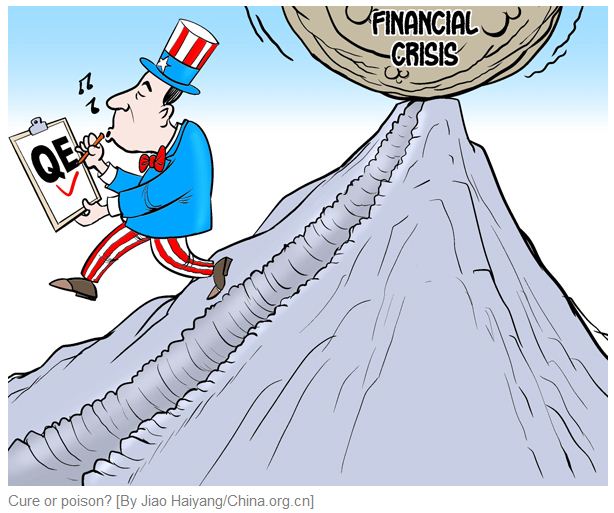
The U.S. economic recovery has been moderate and steady. If the current trend continues, its monetary policy will return to normal within the next few years. Policy adjustment will depend on the recovery of employment and the inflation rate.
The U.S. economic recovery and QE tapering has important implications for the world, and this has been widely debated in China recently. The spillover mechanism is complicated. I will analyze the mechanism from the trade, financial and national wealth channels.
(1) Trade channel: The United States is the biggest consumption market in the world. Its economic recovery will increase its demand for goods from other countries. In November 2013, exports from China to the U.S. increased 17.7 percent year on year, the highest increase since June 2012. The U.S. economic recovery could have positive effects on emerging countries, including China. QE tapering could make the U.S. dollar stronger, which would strengthen its purchasing power and import demand.
(2) Financial channel: There is big interest rate gap between the United States and emerging markets. International capital has flowed into the emerging markets in pursuit of higher investment returns on stocks and real estate. The U.S. economic recovery will produce more domestic investment opportunity. The zero interest rate policy will gradually come to an end. The decreasing interest rate gap will cause the capital to flow back to the U.S. market. The capital outflow will produce some financial risk for the emerging markets. The exchange rate of some emerging markets, such as India, Brazil and Indonesia has significantly depreciated recently, providing clear evidence of capital outflow.
However, the Chinese economy is not as fragile as the other emerging markets. China still has a massive trade surplus, low foreign debt and huge foreign exchange reserves. China's economic growth is still among the highest in the world, so it could produce high investment returns. There is still strict capital control in China, which hinders the flow of capital. Resultantly, China shouldn't be particularly concerned about the financial risk of the Fed's QE tapering.
(3) National wealth channel: China has bought huge amounts of U.S. treasury securities using the foreign exchange reserve. The Fed's QE policy is "printing money" to buy U.S. treasury securities. QE produces an invisible threat to the national wealth of China because the exchange rate of the dollar and the value of the securities will depreciate. From this perspective, QE tapering helps creditor countries. The dollar exchange rate has appreciated to some degree after the QE tapering. This will benefit the foreign exchange reserve wealth of China.
In summary, the U.S. economic recovery and QE tapering is a double-edged sword for emerging markets. It could produce positive effects in the trade channel by increasing import demand. It is also good for the wealth of creditor countries. However, capital outflow could cause some financial risk.
Whether financial risk will produce serious economic consequence depends on the stability and flexibility of an economy. China is the world's second biggest economy and its economic growth is mainly determined by domestic factors. The government should consistently push institutional reform and strengthen fragile areas. The spillover effect of foreign policy should be taken into account when making policy.
The author is an assistant research fellow with the Institute of World Economics and Politics, China Academy of Social Sciences.
Opinion articles reflect the views of their authors, not necessarily those of China.org.cn.